This past Thursday and Friday were spent adventuring in various parts of Texas. There are plenty of pictures and stuff for each day, so I'm splitting them into two. The first takes place entirely in Houston!
Our original plan for Spring Break was to camp around in Texas, exploring ghost towns (which do, apparently, exist) and fighting rattlesnakes and whatnot. You know, Texas-type things. We couldn't find anyone else to join us on this excursion, however, so I just decided to come to Houston, to my friend Robert's house (the man with the ghost town idea) and spend the week there. We couldn't just sit around all week (especially because Robert's siblings drive both of us crazier than we already are), so we put on our thinking caps and did some day tripping.
The first trip can be credited to a book my mother got me for Christmas: 1000 Places to See Before you Die. I checked for Houston, and the only thing listed was something named "The Menil Collection." I looked it up, and it turns out it's an obscure art gallery in the middle of Houston containing a number of important works from the 20th century. Off we went!
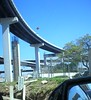
The first thing readers should know about Houston is its resemblence to Hogwarts (as Robert constantly notes). By that I mean that roads never seem to lead to the same place twice. Take a look at that picture, and you may see what I mean--notice especially the toppled "No Sidewalk" signage.
After a wrong exit and a breezy drive through some decidedly unsavory neighborhoods, we managed to find the Menil Collection, a stark white building tucked in a wooded subdivision off the St. Thomas University campus. Facing it was a compact park with several of those modern art sculptures that nobody understands. The building itself is also a representative of the school of modern art, with a minimalist exterior, harsh 90 degree angles, and some weird sail-looking things. Pictures:
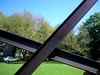
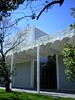
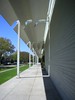
The first three are of one of the sculptures in the park, and the final two are of the gallery. No pictures were allowed in the gallery itself, and I was a nice little boy so I didn't take any. Inside we were treated to a banquet of 20th century paintings, including things by such artists as Pablo Picasso, Andy Warhol, < href="http://en.wikipedia.org/wiki/Piet_Mondrian">Piet Mondrian, Jasper Johns, Mark Rothko (ugh), and Robert Rauschenberg among others. More exciting than the modernist gallery was a substantial serving of some 20th century surrealism, represented by Max Ernst, Man Ray, Giorgio de Chirico, and Rene Magritte (the "Pipe" on his page in Wikipedia was on display in the gallery, even though the picture seems to claim otherwise). Wikipedia's entry on the Menil Collection and even the gallery's own website promises some Salvador Dali pieces, but there were none to be found. Many of the surrealist paintings on display were breathtaking, and several I remembered from my art history book. Besides the 20th century art, the gallery boasted a little sanctuary of ancient and tribal art. As we walked out, we were satisfied in the art portion we had received that day. Also, the museum was free.
The day, however, was far from finished. Having much daylight remaining, Robert decided it was time for me to see one of his favorite places: Quarter-Priced Books. We managed to navigate the Houston road system long enough to find it, and it was indeed everything he promised. Just look at some of the pictures of this place:
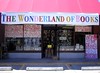
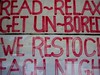
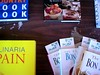
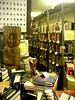
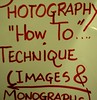
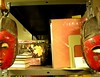
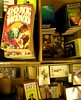
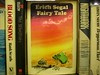
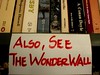
Left to Right: The storefront (it was, in fact, a wonderland); A close up on one of those signs; some cook books on a table outside; inner wonderland (the poster is a list of Iraqi terrorist "most-wanted" types); "How To," A couple of red masks; boxes of paperbacks; an interesting cover; a plug for the "Wonder Wall" (more on that later); a blatant statue of what I think is Teddy Roosevelt.
On the inside the place was unlike any bookstore I've ever been into. There were statues everywhere, including that Roosevelt statue pictured above, as well as many other random things. I'm pretty sure that shop had more copies of The Thinker than I've ever seen in one place. The metal skeleton shelves were punctuated with handwritten callout cards describing the sections one was browsing (and there were numerous sections), and as they all appeared to be in the same handwriting as everything else in the store, I would wager they were all done by the same guy. The guy, who was the only employee in there, was an older man with all the appearance of a trucker or mechanic and none of the eccentric professor-osity of a bookstore owner. He wore a loose gray button-up shirt with a pack of Marlboros in the front pocket, and regarded us with sunken eyes accentuated with prominent bags underneath. His gray hair, matching his shirt, was greased back. The counter he worked behind, scattered with sundry trinkets, seemed less of a workspace and more of an extension of his very being. He, essentially, was the store. I would be very surprised if he wasn't the founder and owner.
We pored over the prodigious selection for what seemed like an hour. I marveled at the many numbers of categories, I have never seen fiction divided in so many ways before. Most interesting was the "Wonder Wall," a long section of shelf which seemed to be dedicated to only the most famous and notable of authors in their most expensive and rare volumes (although many other shelves seemed to claim similar things). I needed to buy something from that Wonderland, if only to acknowledge the old man for bringing into being such a unique experience. I ended up with an Ace Double; a pulp sci-fi deal from somewhere between 1950 and 1970 containing two stories; one on each side.
Even after all that, the day was still young, so we drove off in a random direction hoping that something interesting would find us. Fortunately, it did. Far off in the distance, I spotted this:
The Art Deco Obelisk named after one of my home states was too odd to ignore, so we drove by it--and I was floored when I saw one of those old, magnificent movie theaters hollowed out and recreated into...
A bookstore! Clearly the object of the day was to find awesome bookstores, and this one definitely qualified. The store itself was actually owned by Barnes and Nobles, so the selection was nothing I hadn't seen before, but the presentation was what made this one an A-Lister. All of the feel and mood of a movie theater was still there, only instead of food-stained stadium seating there were rows of books, and instead of a massive projector screen there was a newstand. Pictures:
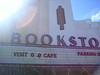

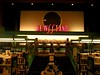
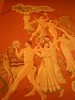
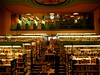

Left to Right: Clever Stop Sign; "Vist Or Cafe;" The rose deco on the ceiling; what used to be the screen area is now the newstand; the greek-style paintings on the walls (huge); a view from the newstand with the balcony cafe; a neon sign advertising various things.
I didn't buy anything from this one. I did, however, give them mad props for creativity.
Before we continued with our little bookstore excursion, we stopped for a heavy lunch at Jack-In-The-Box, a staple of Texas fast food which I had never tried before. Robert, being the expert on this, advised that I order the foremost in arterial nightmares: the Bacon Ultimate Cheeseburger. It was, in fact, the ultimate. I have taken for you a picture of its majesty:
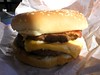
The Ultimately Deadly Burger is not to be consumed without its greasy sidekick, the seasoned Curly Fries. I did not break this sacred law.
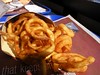
The burger itself basically held me over for the rest of the entire day (I couldn't finish my dinner of fajitas later that night, even). After sealing our circulations' fate, we moved on, stopping at one more bookstore before making the journey back. This one was a chain called "Half-Price Books," not related in any way to our friend at Quarter-Price.
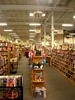
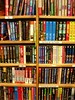
Half-Off was probably the most gigantic used book store I've ever been in. Since it's a franchise, it's clean and orderly and alphebetized correctly and all that, so some of the excitement of used book hunting is taken away. Nevertheless, the selection was nothing short of astounding. The store had also expanded to include movies and music, so we spent a good amount of time browsing through various temptations. I did not indulge, however, being satisfied with my Ace Double from earlier.
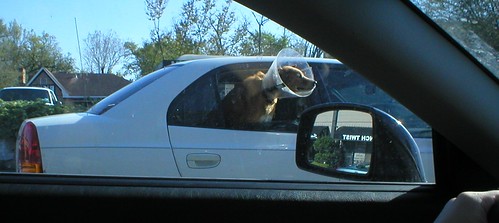
We left Half-Off and began driving back. The trip back was a search for a comic store called Bedrock City, which we found eventually (and which I did not take any pictures of). It also was graced by the presence of this awesome dog in a car next to us.
Coming next time: a journey to the far lands, in search of an ancient tree and a gargantuan war machine.
PS
Look at this hilarious sign: